

The Magiccon Panel showed previews of the upcoming set, The Hobbit, and one of the new cards that was highlighted was the legendary creature Bard, King of Dale. It’s a six-mana-cost 3/5 Human Noble Archer with two relevant replacement effects: drawing you more cards and producing twice the number of tokens.
Although Bard, King of Dale carries a six-mana price tag, its effect is powerful enough to justify consideration as a finisher in slower Standard control archetypes. Traditional control decks often struggle to close games after stabilizing the battlefield, relying on a single resilient threat or an overwhelming source of card advantage.
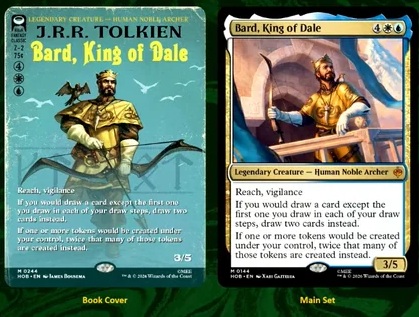
Bard provides both by transforming every extra draw effect into twice the value while simultaneously doubling token production, allowing control players to shift from defense to offense in just a few turns.
One of Bard’s greatest strengths in control is its interaction with repeatable card draw. Once Bard resolves, every draw spell beyond the normal draw step effectively doubles, enabling control decks to quickly refill their hand after trading resources throughout the early and midgame. Rather than simply maintaining parity, Bard allows a control player to pull significantly ahead, ensuring they continue finding removal, counterspells, and additional threats while their opponent struggles to keep pace.
The token-doubling ability is equally important in the current Standard environment, particularly if control lists utilize token-producing planeswalkers, artifact generators, or creature-making enchantments. Instead of relying solely on a single finisher, Bard lets every token-producing effect become a legitimate win condition. A modest board of Soldier, Spirit, or artifact creature tokens can suddenly become an overwhelming army, forcing opponents to answer multiple threats rather than a single creature.
Bard also fits naturally into Bant Control shells, where Green provides ramp to accelerate into six mana, White contributes sweepers and efficient removal, and Blue supplies counterspells and card selection. This color combination already favors long games, making Bard an attractive top-end engine that rewards patient play. Once protected with countermagic, Bard’s 3/5 body with reach and vigilance can also stabilize combat against flying creatures while remaining available to block after attacking.
The biggest challenge for Bard, King of Dale is surviving long enough to generate value, as six-mana creatures are vulnerable to efficient removal. However, in slower metagames dominated by control mirrors or midrange attrition battles, resolving Bard after exhausting an opponent’s answers can immediately swing the game through overwhelming card advantage and token generation.
If Standard continues to favor grindy resource exchanges over hyper-aggressive strategies, Bard has the potential to emerge as a unique control finisher that wins not through raw power alone, but by burying opponents under an avalanche of cards and board presence.
Thanks for reading.